The European Accessibility Act (EAA) has applied since 28 June 2025. Among other things, it covers e-commerce services offered to consumers in the EU. If you sell online to European customers, there’s a good chance it applies to you, even if your business is outside the EU.
This article is practical guidance, not legal advice. Check the details for your business and the countries you sell to.
Who it covers
The EAA covers businesses providing e-commerce services to consumers in the EU. Microenterprises, broadly businesses with fewer than 10 employees and annual turnover or balance sheet of no more than €2 million, are exempt for services. Each EU country has its own national law and enforcement, so details vary.
What “accessible” means in practice
The EAA refers to the European standard EN 301 549, which in turn maps to the Web Content Accessibility Guidelines (WCAG) 2.1 at level AA. In plain terms, people who use screen readers, keyboards, magnification or other assistive technology must be able to find products, understand them and buy them.
The problems I find most often on stores
- Low contrast text and buttons, especially light grey on white.
- Images without useful alt text, including product images and icons used as buttons.
- Forms with placeholder text instead of labels, and error messages that aren’t announced.
- Keyboard traps in menus, sliders, pop-ups and cookie banners.
- Variation selectors and swatches that only work with a mouse.
- Checkout steps that a screen reader can’t follow.
A practical plan
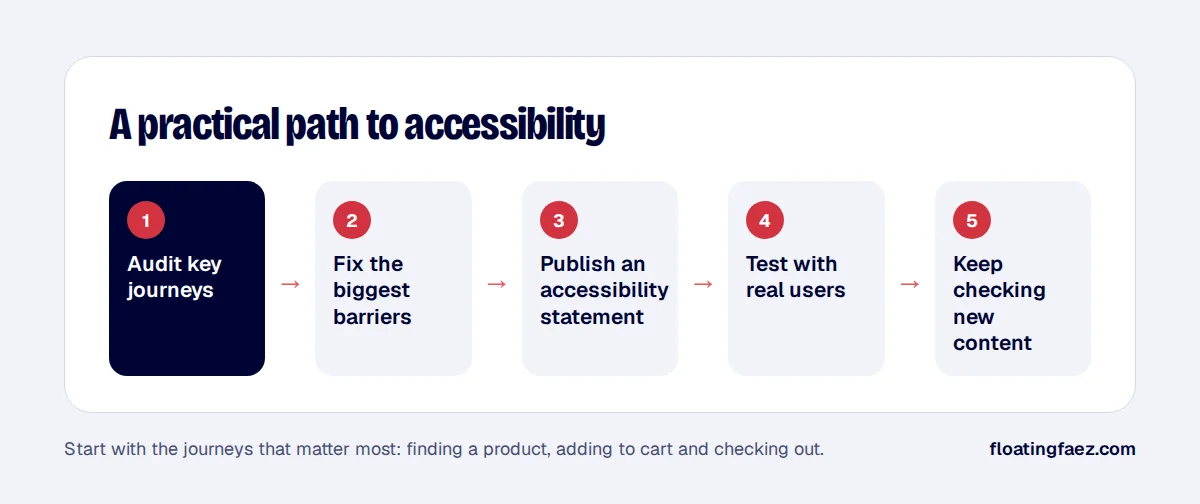
- Audit your key journeys: home, category, product, cart, checkout and account. Use automated tools like axe or WAVE, then test with a keyboard and a screen reader.
- Fix the biggest barriers first, in your theme, page builder settings and plugins.
- Publish an accessibility statement describing your level of compliance and how people can report problems.
- Train whoever adds content: alt text, heading structure, link text.
- Re-check after every redesign or major plugin change.
Accessibility work also tends to improve SEO and conversion: clearer structure, better forms and readable text help everyone. If you’d like an accessibility review of your store, get in touch.